Sunday, March 31, 2019

Underway Again

After seven weeks in the boatyard, we finally got underway again Friday afternoon. Rather than taking the boat directly to The Ford Plantation, we opted to make a quick run 17 miles north to Hilton Head, where we have spent a quiet weekend at the Harbour Town Yacht Basin. We are directly across from the 18th hole of the Harbour Town Golf Links where they are already constructing the stands for the RBC Heritage tournament that begins here in two weeks.

The boat was quite dirty, as happens in boatyards, so I spent most of Saturday just getting the first layer of grunge off until we can get it back home for a real cleanup. 

We would love to go outside in the Atlantic for most of the trip home today, but alas, the weather doesn't appear to be cooperating. It's not going to be awful, but a cold front passes through during the day, kicking up wind and perhaps some squalls. Going south on the waterway is also a bit challenging because of the timing of tides. An arrival at Ford for the best tides late this afternoon has us crossing some shallow areas up here at low tides. We are thinking we can leave here at about about 1 pm, an hour after low tide, and have rising water as we make our way south. We hope to arrive home around sunset and close to high tide at Ford. 

It's been a great weekend.


Monday, March 18, 2019

Sea Level

A few weeks ago, I went to check on my boat at the Hinckley Marine boatyard in Thunderbolt, just east of Savannah. When I arrived, the entry road to the yard was under water. All of the employee cars were parked along the road a few hundred yards from the entrance, and one employee was directing traffic. He told me the tide had gone down already and that I could probably get through and find a dry parking spot, but getting to the dock and my boat might be a challenge. He also recommended a quick car wash that afternoon to get the salt off.

I tentatively made my way in and found all of the employees wearing tall rubber boots and sloshing around the soaked boatyard. I did manage to park in a dry spot and made my way along a narrow wall to get to the docks. While we all know that sea levels are rising, the experience led me to some reading on the subject. This is not a discussion of the causes of climate change, nor is it political. I simply wanted to find out what is happening right here where I live.

There are tremendous tides in our area, and on the day of this experience, they were much higher than average. In Thunderbolt, the high tide that day, February 20, was 9.8 feet while the low tide was -2.1 feet, a big day to be sure. But the measurement of tides is in relation to mean sea level, a number that is constantly rising. The tide gauge at Fort Pulaski is the only official measurement in the state. It was commissioned in 1935 and, since that time, the sea level has risen more than nine inches, a rate of more than a foot every hundred years. And the rate of rise is increasing. The low projections show a sea level rise of two feet by the end of this century while the most extreme show a rise of more than 10 feet in the same period. Almost all of the increase is attributable to the water rising rather than land sinking.


Someone asked me recently why the sea level would rise when glaciers melt that are already in the sea. It doesn't. Sea level rise is caused by runoff from the melting of glaciers that are on land, and by the expansion of sea water as its temperature increases. There are conflicting estimates of how much is caused by each of these factors, but there seems to be a developing consensus that thermal expansion of sea water will play the larger role long term.

Around here, there are signs everywhere of the issues that sea level increase is already causing. More and more frequently, U.S. Highway 80 to Tybee Island has to be closed as it is under water. Low areas along the Thunderbolt area are also routinely disrupted. A portion of President Street in Savannah is being elevated five to eight feet to prevent flooding.

Projecting the exact time that any area of the country succumbs to what is called "chronic inundation" is extremely difficult, as it involves estimating how trends change in the future. But we do know now that Savannah, along with Miami and New Orleans are high on the list of cities that will be affected the most quickly. For a more detailed study by the Union of Concerned Scientists pointing this out, see "When Rising Seas Hit Home". An interesting exercise is an interactive map published online by NOAA where you can zoom into an area of interest and slide the sea level up as much as 10 feet above its current level. For our area of the world, it looks pretty scary even to see the effect of a one or two foot rise.

Work has progressed slowly on the few projects for the boat. I hope to have it out of the boatyard this week or next.

Saturday, March 9, 2019

Where's the Boat?

Our boat came equipped with an Automatic Identification System ("AIS") receiver, a device I have never had on a previous boat. The  electronic chart display includes a symbol for every commercial vessel and many other boats within radio range, each with a velocity vector (indicating speed and heading). Each ship symbol on the chart can reflect the actual size of the ship, and its GPS position. By "clicking" on a ship symbol, I can learn the ship name, course and speed, classification, call sign, registration number, Maritime Mobile Service Identity ("MMSI") number, and other information. Maneuvering information, closest point of approach (CPA), time to closest point of approach (TCPA) and other navigation information, more accurate and more timely than information available from radar plotting, can also be available. If I wish to make radio contact with the vessel, I can call it on the radio by name. This information is available to every AIS receiver user, and is also available to the public at www.marinetraffic.com. A zoomed out picture from that website of ships all over the world generally looks like this: 

AIS transmitters are only required on commercial ships, but any boat can have a simple receiver or a transceiver. The ability to see other ships, plot them, and stay out of their way is an invaluable safety device. Equally important is the ability to not only see but be seen. Thankfully, the costs of what are called "Class B" AIS transceivers (for non-commercial vessels voluntarily equipped) has become very affordable for non-commercial boat owners. And so it is that as of yesterday, Division Belle is equipped with an AIS transceiver. The link above on the blog called "Where's the boat?" will now take readers to the marinetraffic.com website for real-time information on the location of Division Belle. 

I won't be able to get away with anything anymore, but I can always just turn it off if I wish to hide. See the boat's current location here.

Monday, February 11, 2019

Appreciation for the U.S. Coast Guard

united states coast guard 
Multimedia Release

U.S. Coast Guard 5th District Mid-Atlantic
Contact: 5th District Public Affairs
Office: (757) 398-6272
After Hours: (757) 434-7712
5th District online newsroom
The shipwreck that changed the Coast Guard forever
This video outlines the Marine Electric shipwreck and the incident’s lasting impact on the Coast Guard.  
Editors' Note: Click on images to download high resolution version.
Story and artwork by Petty Officer 2nd Class Corinne Zilnicki
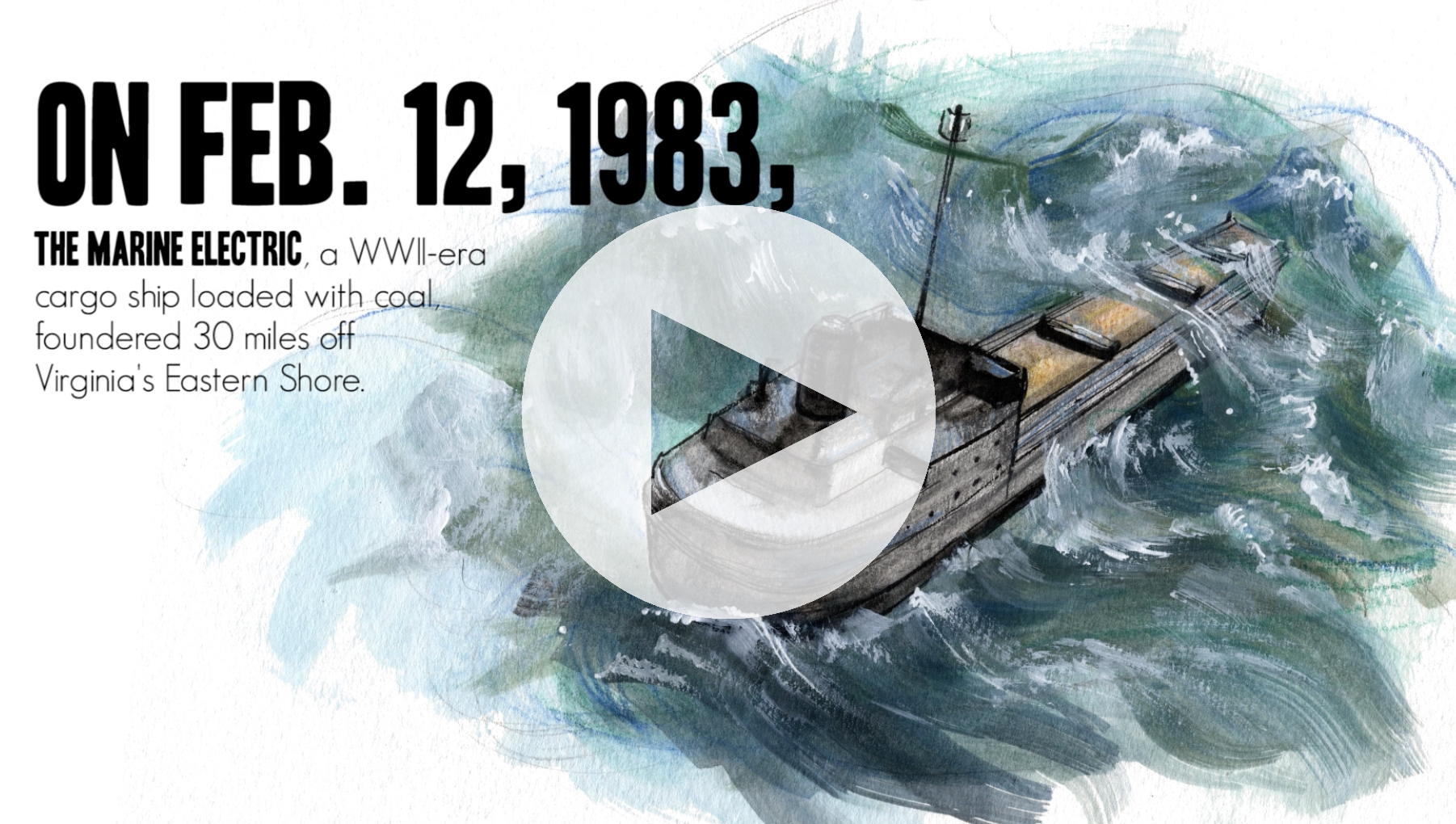
When the clock tolled 12 a.m. on Feb. 12, 1983, the 605-foot cargo ship Marine Electric trekked northward 30 miles off Virginia's Eastern Shore, plowing slowly through the gale-force winds and waves stirred up by a winter storm.
An able-bodied seaman relieved the watch and peered forward, noticing for the first time that the ship's bow seemed to be riding unusually low in the water. Dense curls of green ocean rushed over the bow, some of them arching 10 feet over the deck before crashing back down. The crew had been battling 25-foot waves for hours, but until now, the bow had bucked and dipped as normal.
Now it seemed only to dip.
Over the next two hours, the waves intruded with increasing vigor. The entire foredeck was swallowed in 6 feet of water. The main deck was completely awash.
At 2:30 a.m., the ship's master, Phillip Corl, summoned his chief mate, Robert Cusick, to the bridge and shared his fears: the bow was settling, they were taking on too much water, and the crew was in real trouble.
At 2:51 a.m., the captain made the first radio distress call to the Coast Guard.
"I seem to be taking on water forward," Corl said. "We need someone to come out and give us some assistance, if possible."
By the time assistance arrived, the Marine Electric had listed, rolled violently to starboard, and capsized, hurling most of its 34 crew into the 37-degree water. Chaos ensued.
Chief mate Cusick surfaced with a gasp, managed to get his bearings, and spotted a partially-submerged lifeboat nearby. After swimming through towering waves for 30 minutes, he pulled himself into the swamped boat and started thrashing his legs to stay warm.
"All the time I kept looking out and yelling out, 'lifeboat here,' just continually yelling out to keep myself going," the chief mate said. "Then I waited and prayed for daylight to come."
The Coast Guard had long since dispatched an HH-3F Pelican helicopter crew from Air Station Elizabeth City, North Carolina, and directed the crews of several cutters to the Marine Electric's position, but the tumultuous weather conditions slowed the rescuers' progress.
Naval Air Station Oceana had to recall available personnel before launching a helicopter crew, including rescue swimmer Petty Officer 2nd Class James McCann.
At 5:20 a.m., the Coast Guard helicopter crew was the first to arrive on scene. They had expected to find the Marine Electric's sailors tucked into lifeboats and rafts, but instead, they found a blinking sea of strobe lights, empty lifeboats, and bodies strewn below.
The Navy aircrew arrived and deployed McCann, who tore through the oil-slicked waves, searching for survivors. He managed to recover five unresponsive sailors before hypothermia incapacitated him.
The Coast Guard crew scoured the southern end of the search area and discovered one man, Paul Dewey, alone in a life raft. They dropped the rescue basket so he could clamber inside, then hoisted him into the helicopter. About 30 yards away, they spotted Eugene Kelly, the ship's third mate, clinging to a life ring, and lowered the basket to retrieve him.
Cusick remained huddled in his lifeboat until the sailors aboard the Berganger, a Norwegian merchant vessel whose crew was helping search the area, sighted him and notified the Coast Guard. The helicopter crew retrieved him in the rescue basket, then took off for Salisbury, Maryland, to bring the three survivors to Peninsula Regional Medical Center.
Meanwhile, more Coast Guard and Navy rescue crews converged on the scene to search for survivors.
Coast Guard Capt. Mont Smith, the operations officer at Air Station Elizabeth City, had piloted a second Pelican helicopter through turbulent headwinds for over an hour in order to reach the site.
He and his crew scanned the debris field below for signs of life. The people they saw were motionless, and it was difficult to determine whether they were simply too hypothermic to move, or deceased. Smith spotted one man and hovered over him, squinting through the whipping snow, trying to decide what to do.
"We all felt helpless," Smith said. "There was no way to know if the man was dead or alive. We had to try something."
Petty Officer 2nd Class Greg Pesch, the avionics electrical technician aboard the helicopter, volunteered to go down on the hoist cable. After some deliberation, Smith agreed.
Pesch's descent in the rescue basket was a harrowing one.
"The whole world seemed to be churning," Smith said. "I struggled to maintain a smooth hoist, but I know it was erratic."
Once in the water, Pesch grappled with the basket, trying to hold it steady as he guided the unresponsive man inside. It took several attempts, and then he scrambled into the basket himself and ascended back to the helicopter alongside the victim.
The aircrew spotted another potential survivor, and although Pesch attempted to descend again, the hoist cable spooled back on itself on the drum. The crew was forced to abort their mission and departed for nearby Salisbury Airport, where the man they had pulled from the water was pronounced dead on arrival by paramedics.
Dewey, Kelly and Cusick were the only men pulled from the ocean alive that morning. Their 31 shipmates had either succumbed to hypothermia or drowned.
All told, Coast Guard, Navy, and merchant vessel crews recovered 24 bodies from the scene of the capsizing. Seven were never found. It is likely the ship's engineers were trapped belowdecks when the vessel capsized.
"Throughout Coast Guard history, the missions of the service have been written in blood," said Dr. William Thiesen, historian, Coast Guard Atlantic Area. "Such was the case with the loss of the Marine Electric. This tragic event led to stricter marine safety regulations and the establishment of the Coast Guard's premiere rescue swimmer program."
While the incident itself served as the catalyst for the major changes to the Coast Guard and maritime community at large, the rigorous efforts of Coast Guard Capt. Domenic Calicchio brought the necessity for such changes into sharper focus.
Calicchio was one of the three marine safety officers charged with investigating the capsizing and sinking of the Marine Electric. The board of inquiry launched their investigation on July 25, 1984, and examined every aspect of the WWII-era cargo ship, its upkeep, the events leading up to its demise, and the Coast Guard's rescue efforts on that morning.
The investigation revealed that although the Marine Electric had been recently inspected several times by both the American Bureau of Shipping and the Coast Guard, marine inspectors had failed to note several discrepancies or recommend needed repairs. Investigators concluded that the casualty had most likely been caused by inadequate cargo hatches and deck plating, which allowed the crashing waves to flood the vessel's forward spaces.
Calicchio felt the Coast Guard needed to revamp its marine safety procedures and demand more of maritime companies, but more importantly, that the Coast Guard needed to demand more of itself.
His push for reform resulted in several additions to the Coast Guard's marine safety protocol, including guidance on hatch cover inspections, and new requirements for enclosed lifeboats and their launching systems, for ships' owners to provide crews with cold water survival suits, and for flooding alarms to be installed in unmanned spaces on vessels.
The Coast Guard also tightened its inspections of 20-year or older ships, which led to the near-immediate scrapping of 70 similar WWII-era vessels.
"Calicchio embodied the service's core values of honor, respect, and devotion to duty," said Thiesen. "He championed marine safety and pursued the truth even at the risk of his career of a Coast Guard officer."
While the Coast Guard changed many policies to make a safer marine environment after the the sinking of the Marine Electric, the service continues to make improvements on its marine safety program today. By 2025, it is estimated that the demand for waterborne commerce worldwide will more than double. The Coast Guard has published its Maritime Commerce Strategic Outlook in preparation for the increasing demand. 
The Marine Electric shipwreck also served as the genesis of another crucial development: the Coast Guard rescue swimmer program, which was established in 1984. The program's physical fitness standards, training and organizational structure were developed over a five-year implementation period, and in March of 1985, Air Station Elizabeth City became the first unit to receive rescue swimmers.
The first life was saved two months later.
The Marine Electric, a 605-foot cargo ship, as seen underway before its capsizing and sinking on Feb. 12, 1983. The converted WWII-era ship foundered 30 miles off the coast of Virginia and capsized, throwing most of its 34 crew into 37-degree water, where 31 of them drowned or succumbed to hypothermia. (U.S. Coast Guard photo)
-USCG-
Bookmark and Share

Coast Guard emblem 2014
   Questions for the Coast Guard? 
   Contact Us
For more Coast Guard news, visit our online newsroom here. 
STAY CONNECTED:
Visit Us on YouTube
Visit Us on Twitter
Visit Us on Facebook
Sign up for email updates
SUBSCRIBER SERVICES: 
Manage Preferences  |  Unsubscribe  |  Help

Privacy Policy | GovDelivery is providing this information on behalf of U.S. Department of Homeland Security, and may not use the information for any other purposes.
This email was sent to john@samfordemail.com

This email was sent to john@samfordemail.com using GovDelivery Communications Cloud on behalf of: U.S. Coast Guard · U.S. Department of Homeland Security · Washington, DC 20528 · 800-439-1420
GovDelivery logo

Sunday, February 10, 2019

Logbook summary -- and feeling blessed

Now that the boat is in the local area, I am transferring the scratchy log information I make underway to a more organized spreadsheet. The engine passed the 3000-hour mark on the trip home and the onboard mileage log shows it to have covered 19,867 nautical miles since new, measured by the GPS. I have personally run it now some 649 nautical miles in roughly 100 hours, although for more than half of that time either Paul Hamilton or Jim Trolinger was at the helm. This 13-year-old boat has averaged covering around 1,500 nautical miles a year in 230 hours. For both myself and the two previous owners, the average speed seems to work out to about 6.5 knots. The boat cruises at 8 knots, but the slower average is caused by no-wake zones, docking, shallow areas, etc.

The "shakedown cruise" from Herrington Harbor, near Annapolis, Maryland down to Savannah has been a great opportunity to get to know the quirks of the boat and, assisted by my able crew, a number of mysteries have been solved and issues resolved, or at least diagnosed. With some luck, there will be nothing but maintenance and new squawks to deal with after this visit to the boat yard. I plan to have the varnish re-done in the next few weeks. The much-needed paint job for the upper white portion of the boat will have to await another year's budget.

I am having a blast and feel incredibly blessed to be doing this again. Given my age, it seems to make sense to pursue something I love this much while I am still capable. Now that the boat is back from the cold Maryland winter, I am looking forward to enjoying it with my bride, who has graciously embraced this quest along with me. We began boating together before we were married, and some of our fondest memories are the many great boating trips we have enjoyed from the Gulf coast to the Bahamas to Maine. I have no doubt that new memories will be made on this boat as well. As the song said, "Our weary eyes still stray to the horizon, though down this road we've been so many times".

I have added a few more photos to the album. I will report back when we move the boat up the Ogeechee River to Ford, which should be in a few weeks. Thanks for tuning in.

Friday, February 8, 2019

Back in Georgia

Just a quick note that we have safely delivered the boat to Savannah. We arrived right at noon at the Hinckley Boat Yard in Thunderbolt after spending last night at the Skull Creek Marina on Hilton Head. It is good to be home.

Thursday, February 7, 2019

The ocean is way more fun than the Intracoastal Waterway

We arrived safely at the Charleston City Marina yesterday afternoon around 5:30. It was a spectacular day at sea, and very relaxing compared to the constant attention required to drive in the Waterway, with twists and turns, bridges, and shallow spots to look out for. With another day of calm seas promised today, we decided to change our plans and go to sea again. We are headed now to Port Royal Sound at the north end of Hilton Head, so we are bypassing Beaufort altogether, and giving us a short run tomorrow to Savannah. We should get inside the sound and somewhere to anchor or tie up before dark today.

Check out the photo album, as I have added a few this trip. 

Wednesday, February 6, 2019

First time at sea

It is 10 am Wednesday morning, February 6, 2019, and we are officially at sea for the first time on Division Belle. Seas are very calm with gentle swells of less than two feet. The wind is from the east at six knots. We left Georgetown, SC this morning at 8 am and came down the river to enter the ocean from Winyah Bay. We are headed for Charleston and should reach the ship channel there by around 4 pm.

Our first two days have been outstanding with beautiful weather and only a few shallow spots to navigate in the Intracoastal Waterway. Monday night was spent in North Myrtle Beach at a friendly marina called Barefoot Resort. A guy there runs a "concierge" service and for less than the price of Uber he took Paul Hamilton to Walmart to purchase a mount for our new salon TV. It is now installed with satellite TV working, but only a temporary antenna stuck to the window (purchased for $15 to allow us to watch the Super Bowl Sunday night, such as it was). There was no restaurant open on the property so we dined onboard.

Yesterday, Tuesday, we spent the entire day in t-shirts driving from the flying bridge. We departed Myrtle Beach at 9:45 and arrived at 4 pm in Georgetown, a historic and quaint little town with houses dating to before the American revolution. We had dinner last night at the "River Room", which was excellent. 

The high in Georgetown today is expected to be 74 degrees, and Charleston will be even warmer as we continue to move south. We expect to travel from Charleston to Beaufort, SC tomorrow and on to Savannah Friday.

Monday, February 4, 2019

Back on the boat

We are back on the boat. Paul Hamilton and I drove up from home to Southport, NC yesterday in a rental car. It is interesting that we could drive up in just over five hours, but the trip home on the boat will take more than five days (50 miles per hour or 50 miles per day). The weather was cold and rainy when we arrived, but promises to be great for the week. We had planned to head out this morning with stops in Myrtle Beach, Georgetown, Charleston, and Beaufort, SC, but it now appears we will be here one more day to finish up a few items.
We might have some options along the way to go offshore, depending on the weather. Georgetown to Charleston would be a good day to do so, as would Beaufort to Savannah, but we shall see.

The boat has been something of a movable repair project so far. Many issues have been resolved in Southport and there will no doubt be many more as we arrive close to home. This is, all-in-all, a great boat, but apparently no one did any maintenance for the past several years. We are making progress, and I won't bore you with the details.


We came up bearing the new flag of our home port at The Ford Plantation. We hoisted it today on the bow.

UPDATE @ 10  PM Monday 2.4.19: Many things came together early today, and we did indeed get away from Southport at around 10 am this morning. It was a beautiful day of cruising, with temperatures reaching around 70. We arrived mid-afternoon in Myrtle Beach, SC. 

Please click "Where's the boat?" above to track our progress.


Friday, January 18, 2019

Live Firing

I am in Southport, North Carolina, the end of the current voyage. You can see the boat out at the end of the dock in a live feed here. My crew Paul Hamilton and Jim Trolinger headed home today.


Maintaining the strange Krispy Kreme hat
tradition started with my son in the Bahamas.
They have been great company and terrific contributors. Paul fixed the satellite TV and both helped figuring out several other items. Jim was chief cook while Paul was bottle washer. Both were excellent deckhands and we took turns on one-hour shifts at the helm every day. Since Paul is president of our POA and Jim of our club, I had an opportunity to tell them both how they need to run things. I think a good time was had by all, and these two will be gladly welcomed back if they want to help out on another trip. I will stay until tomorrow morning to get some work lined up with the Zimmerman Marine office here. 

This has been a "shakedown cruise" for the new boat. All went well, but we did have a few delays and heart-stopping moments. We found this stretch of waterway to have numerous areas where the depth in the center of the marked channel is too shallow to transit. We would watch the depth finder and slow to a crawl when it became 10 feet or less in our 6-foot draft boat. We softly ran aground three times over the last several days, but in each case we were able to back up and feel our way through.

Tuesday evening was spent at a boatyard near Morehead City where my trusty crew managed to put together various fittings so that we could empty sewage at the marina here that still has its pump out system up and running in the winter. We had about 100 statute miles to cover Wednesday and Thursday to get here, and we planned to cover about 2/3 of that distance on Wednesday to have a short day yesterday. I admit I am out of the habit of checking Notices to Mariners, so we were somewhat shocked at 1:00 pm when we came to an area of the  Intracoastal Waterway that was closed due to live firing exercises at Camp Lejeune, NC.
Checking by radio we found that the entire waterway and an area 15 miles out to sea was closed for the next three hours until 4 pm. There was nothing to do but drop an anchor and wait. Following the delay, we made it to Alligator River Marina, requiring us to travel 65 statute miles yesterday to reach our destination. We arrived here at around 3:30 pm.

I would have to say the strangest incident was when we were maneuvering waiting for the Wrightsville Beach bridge opening and the stern thruster stuck in the on condition, moving our stern to port and spinning us around in the narrow channel. Paul Hamilton was at the helm and remained calm and cool in the unexpected situation. I grabbed the stern thruster joy stick to wiggle it back and forth, and found we could stop it from moving us if the stick was held in the starboard position. The thruster circuit breaker did not turn off the problem but made it impossible to stop ourselves by holding the control, so it needed to remain turned on. Ultimately, we found a big red emergency shutoff button for the stern thruster that stopped the problem until we can get it fixed. I have no idea where the bow thruster shutoff is located, but you can bet I will locate it before casting off again.

So all in, it was a successful shakedown trip, and great fun with two good friends. My crew departed at 8:30 this morning, looking as scraggly as they did upon their arrival in Norfolk in sub-freezing temperatures. Thanks for the help guys, and safe travels.
The Division Belle crew is granted shore leave


Tuesday, January 15, 2019

Why are you guys starting so late?

My new crew members Jim Trolinger and Paul Hamilton reported for duty in Norfolk, Virginia on schedule Friday morning, January 11, 2019.We headed out early Saturday and stopped for fuel at Atlantic Yacht Basin, about eight miles down the Intracoastal Waterway and one of the least expensive diesel fuel stops on the east coast. As we slowly pumped 500 gallons aboard, the dockhand asked: "Why are you guys starting so late?"

The simple answer is that I had hoped to have the boat out of the shop and launched in November or early December, but it didn't happen until January 2. As a result, we have been fleeing winter weather as we creep south on the Intracoastal Waterway. Annapolis, where I started, had eight inches of snow that began Saturday and continued into Monday. I believe Norfolk even got a dusting after our departure. For us there was no snow, but it has certainly been windy and cold, and we had a good bit of rain Saturday night and Sunday. This morning it was around 32 degrees in Belhaven, North Carolina and we might have a few warmer days before a winter storm again reaches the east coast Sunday night. We have only seen two recreational boats moving in four days.

The cold has not really caused any issues running the boat, but most marinas have their water turned off for the freezing temperatures. We were able to fill up when the boat was launched but not elsewhere as we spent a few days in Herrington Harbor. In Norfolk the water was also on so we filled up Friday night. Since then there has been no water, but we have called ahead to make sure we can refill tonight near Morehead City.

My crew members have been great company and excellent hands. They are handling the lines and fenders well, helping to troubleshoot issues and fix things, and we are all rotating the helm duties during the day. We should make it to the twin cities of Beaufort/Morehead City, North Carolina by tonight and on to Southport at Cape Fear by Thursday.

Tuesday, January 8, 2019

Norfolk, Virginia

The lovely Laura Lee and I made it safely to Norfolk, Virginia Sunday after two long days of travel. I am still getting to know the boat and its equipment, but it gets better by the day. The trip was uneventful except for an adventurous effort at docking in high winds Saturday afternoon.

Sunday evening we were treated to a visit from our old friend Mollie Sawyer and her son Zachery. Mollie is just a sparkling personality, and we were only reminded how much we have missed her. She and her family are temporarily living in Norfolk while her husband Mark completes his final year before retiring from the Coast Guard.

For readers who do not know her, Mollie was director of fitness at The Ford Plantation until just over three years ago when Mark was reassigned from Savannah to Paducah, Kentucky. She created from scratch the outstanding fitness program at the Ford Sports Barn that continues to be maintained by her successor, John Lindsey. In the process, Mollie should get full credit for helping me turn around my own slovenly ways. While working out with her, riding a bike, and watching my diet, I was able to get in better shape, and not incidentally lose about 25 pounds. The weight mostly remains off today, not counting the little upward blip brought on by the holidays. It was great catching up, and we hope to see her again soon.

Laura Lee headed home Monday, leaving me to mess about with the boat while I await my crew members who arrive Friday. I have had plenty to do. Tomorrow and Thursday I will be provisioning for a week of cold travel, which of course requires grog rations for the crew.

Traveling by boat this time of year in Maryland and Virginia is made more difficult as marinas prepare for winter. We were unable to refill the fresh water tank before leaving Herrington Harbor because the marina water was shut down for winter. Our stop Saturday night in Reedville, Virginia also had no water, and in fact we never saw a single human being while we were there. We were fortunate to refill the water here in Norfolk, but I was told it too will be turned off tomorrow in anticipation of a low tomorrow night of 30 degrees and Thursday night of 27 degrees. It is time to get moving to the south. 

We'll be reporting in for those interested in our travels.  Stay tuned. The adventure continues.

Saturday, January 5, 2019

Starting Home

This morning started out chilly and raining as we began our journey to bring Division Belle home to Georgia. But the weather had actually warmed in the last 24 hours. It was in the low 40's today compared to yesterday morning when it was around 30 degrees with icy spots on the docks. We departed from Herrington Harbor North Marina in Deale, MD at 7:15 am, and we are now underway in the Chesapeake Bay. We plan to stop at Reedville, VA this afternoon, about 2/3 of the way to Norfolk, our destination tomorrow.

I actually thought about turning back this morning, due to fog. Visibility was less than one mile and I am not an expert on the radar on this boat. However, we decided to run for awhile and the fog gradually lifted as we moved south. The weather is clearing now, but wind has picked up to 15 to 20 knots from the west, so it's a little bumpy in the bay. 

It seems a very long time since spending my first few nights on the boat in October. I have promised to avoid writing about maintenance and repairs because they are boring subjects -- but let's just say a lot has been done to the boat, including a shiny new paint job for the hull. The paint work and numerous other tasks were handled by Zimmerman Marine at their Herrington Harbor location. They did beautiful work and were a pleasure to work with.


The lovely Laura Lee and I drove a rental car from Savannah to Annapolis last weekend so that we could bring more "stuff" to the boat. We spent the New Year's holiday in Annapolis and the boat was launched on Wednesday, January 2. After a couple of days provisioning, and one brief sea trial, we are finally underway.

The plan is for Laura Lee to fly home from Norfolk and my friends Jim Trolinger and Paul Hamilton will join me there on January 11 for about a week to help bring Division Belle part of the way home to Georgia. It is the nature of traveling confined on a boat that we shall either be much better friends after the trip or not like each other at all. I predict the former. 

It is normal in a deep-draft seaworthy boat to want to get out in the ocean on delivery trips. There are few worries about shallow spots, it is not necessary to hand steer all day, and there is little traffic to dodge. The boat can be set on autopilot and it is a relaxing journey just keeping a lookout. But moving down the coast from Norfolk, Virginia into the Carolinas presents three significant obstacles to traveling offshore: Cape Hatteras, Cape Lookout, and Cape Fear. Each of them juts out into the Atlantic and requires getting well offshore to go around. The outside trip also requires long legs with nowhere to take shelter if the winds and seas pick up. As a result, the inside route is preferable to most people, and it is shorter by about 50 nautical miles from Norfolk to Southport, NC, south of Cape Fear.

There are a few options that can be considered on the inside routes. Norfolk is Mile Zero of the Intracoastal Waterway (ICW), and one can just follow it for the entire route, or if the weather is good, it shortens the route a bit to go outside from Morehead City to Wrightsville Beach and rejoin the waterway to Southport, just south of Cape Fear. At the beginning of the trip south, it is also possible to shave some distance by going outside by Virginia Beach and back into the sounds at Oregon Inlet, but the inlet is notorious for shifting shoals and shallow spots. Finally, from the Albemarle Sound, there is a shortcut across the sounds to rejoin the ICW in the Neuse River. If the weather is good, our route will be down the waterway from Norfolk to the Albemarle Sound, the shortcut across the Albemarle, Croatan, and Pamlico Sounds, and then rejoining the waterway at the Neuse River and down to Morehead City/Beaufort, NC. From there, weather permitting, it will be out in the ocean to Wrightsville Beach and then back inside to Southport. That would put us almost to South Carolina and close to home.


I have no idea how far we will get in a week, but the joy of a slow 8-knot boat is that it doesn't really matter. It's all about the journey, and we shall enjoy every minute of it.

Friday, December 7, 2018

Was ignorance bliss?

The first boat I ever owned that was large enough to travel and sleep on was a 38-foot Californian that I bought in 1990 through a shady broker near Mobile, Alabama. I was 40 years old and newly single, and a boat that I could travel on had been a lifetime fantasy. The internet and its ability to search the world for every boat listing was not in existence. I just saw a boat in a marina with a "for sale" sign. I liked it, especially for the price. 

I had never heard of a survey or an engine survey, much less a full-blown pre-buy inspection, but the broker assured me he had done a survey and everything was perfect. He asked if I wanted to see the engine room, but I told him no. After all, I wouldn’t learn anything from seeing an engine room. The one thing I had going for me with boats was that I was a pilot and knew how to navigate and read charts. There was no GPS back then. I assumed any boat was like a car or the ski boat I had owned and wouldn't need much attention.

We did a sea trial that I called a “test drive” with the owner, a half-crazy Cajun from Louisiana. It was a Saturday morning and the broker brought his girlfriend along. She started drinking at around 9:00 am and continued all day, maintaining a perfect balance right along the edge of consciousness. 

When I closed on the boat, the owner said it was owned by various members of his family and requested several checks to different names, each under the $10,000 reporting amount. I was contacted about this a year later by the IRS and gave them the requested list of checks and amounts. I’m surprised no one from Louisiana came after me.

There were a lot of interesting features to that first boat. The sinks and shower drains had been cut off below and went straight into the bilge of the engine room. The broker told me it was a great system as the soapy water kept the engine room bilges clean. It sounded perfectly logical to me, but it was really pretty nasty. The previous owner also said it was unnecessary to use the “black water tank” and marina pumpouts for sewage, and to just leave the valve set to have the toilets flush straight overboard. I came to find out this is not exactly a legal or recommended practice, except when one is far out to sea.

Not long after I bought the Californian, while cruising, one of the engines started accelerating on its own, even as I pulled back the throttle, something I now know is called a “diesel engine runaway”. I was in the Intracoastal Waterway with my three children on board. I pulled the throttle all the way back while it kept accelerating. I pressed the "Stop" button and turned the ignition switch off, to no avail. I had no choice but to put it in neutral, as we were spinning around in a circle on one fast engine in the waterway. Being in neutral allowed the engine to accelerate even more, pegging the tachometer. It seemed to take a very long time running all out until it “threw a rod”, or whatever, and came apart internally. It stopped, with smoke billowing out of the engine room. 

I was standing there at the helm dumbfounded, with no idea what had just happened or what to do. Some kind and experienced souls from another boat rafted up beside me and a guy jumped on board with a fire extinguisher in hand to check the engine room, while another got my three kids into life jackets and moved them to his boat. Thank God someone knew what to do. There was no fire, but the engine was shot. I had not handled the emergency at all well, but everyone was fine. They pushed us over to the nearby marina dock, where we spent the night and figured out what to do next.

A few months after having the engine repaired, I got an unrelated call from my insurance company one day saying that they wanted to survey the boat the next time I had it hauled out of the water. I don’t think I even knew I needed to have it hauled out periodically, but told them I would set something up. Around the same time someone introduced me to the late Sonny Middleton, who was owner of Mobile Hatteras, A&M Yacht Sales, and the Dog River Marina (boatyard) in Mobile. I took the boat over to him and asked that he contact the insurance company to have their surveyor there and haul the boat out, fixing anything that needed to be done in the process. While I wasn’t there, it was reported to me that when the boat was lifted out, the hull was “flexing” under its own weight in the straps of the lift. The insurance company pronounced it not seaworthy and it was confined to port until the hull could be strengthened to the company’s satisfaction.

It’s a long story, but Sonny became a dear and trusted friend. He somehow got the hull strengthened with new “stringers”, got the boat put back together, and sold it to someone for me at quite a loss, but it was a cheap boat to begin with. He sold me a good 43-foot Hatteras that I used for about three years, and also sold me the next boat I owned: a Fleming 55’. That was followed in 2000 when I purchased a Fleming 72’. The Flemings were great long-range oceangoing boats, but their semi-planing hulls allowed them to cruise at around 16 knots. I came to love seaworthy boats with a long range, and the adventure of lengthy offshore passages.

Sonny also introduced me to Captain Alvin Stacey, who accompanied me on my first crossing of the Gulf of Mexico in the Hatteras, went on several trips with me on the Fleming 55’, and oversaw the commissioning of the Fleming 72’ in California. Alvin travelled with me on the Fleming 72’ up the coast of California, down to Puerto Vallarta in Mexico, and then with two mates brought it through the Panama Canal and delivered it to me in the Bahamas. Everything I know about running and maintaining boats came from my relationships with Sonny and Alvin, along with learning the hard way from mishaps I had along the way. Sadly, Sonny passed away last year, although I was not aware of it until very recently.

Among the mishaps, I have suffered a small engine room fire, failure of a "shaft coupler" so that the engine was disconnected from the shaft and prop, several groundings, broken bow thrusters right when you need them to dock, crab trap entanglements, a boat sinking in the boatyard from a loose seawater pump hose, and a stabilizer fin knocked off. I spent a night on the Hatteras in Marker One Marina in Clearwater, Florida and was rescued by the Coast Guard there the next morning after the marina docks were destroyed in the "No Name Storm" or “Storm of the Century” in 1993. I’ve pretty much had every calamity you can imagine, but none of them have been life-threatening.

Today I am certainly no mechanic, but I have spent a lot of time in engine rooms figuring out problems and making small repairs on boats. Along the way I gained a captain’s license, and I have spent countless months cruising along the Gulf coast, in the Florida Keys, and from Maine to the Bahamas on the east coast. I do think I have learned to ask the right questions, to get expert help when I need it, and to deal with people I trust. For Division Belle, I dealt with Ray Currey as the broker, whom I have known for years at Burr Yacht Sales in Annapolis. I had a good survey and engine survey, and the most amazing inspection one could imagine done by Steve D’Antonio. 

Steve is well-known in the industry for his published articles in trade magazines, his seminars for boat owners on systems and maintenance, and for his very thorough pre-purchase inspections of boats. These inspections typically require two days, full-time on the boat. They cover every single component and system. I received a report with 168 observations and recommendations and 877 photographs of important components of the boat. The recommendations are divided up into the following sections: Cabin & Decks, Electrical System, Engine, Peripherals & Running Gear, Hull, Plumbing, and Systems. They are also placed into four categories ranging from urgent matters to more long-term issues. I would never purchase another boat without an inspection by Steve D'Antonio. While not inexpensive, it is a small price to pay to avoid very costly mistakes, and to help negotiate a price that is fair in view of the boat's condition. It has already saved me money and future trouble. The results not only tell the purchaser what needs to be fixed to be safe and reliable immediately, but also provide a blueprint for future maintenance and long-term improvement of the boat.

So I believe I have done this purchase correctly. This is a great boat with great systems, but it is 12-years-old and there are things that have not been maintained and needed attention. I think I now know most of the issues. I have spent the time since purchase sorting and assigning the list of projects. The most important safety and reliability issues will be fixed before I begin moving the boat south in January. The boat will be safer and more reliable as a result. But the question arises: is it more fun being blissfully ignorant or having the experience and knowledge to do it right?

The poet Thomas Gray said that: "Where ignorance is bliss, 'tis folly to be wise." There was a pure rush that I felt when I first bought a boat, learned to dock it properly, first crossed the big bend of Florida from Apalachicola to Clearwater, crossed it from Clearwater back to Apalachicola with only our dog Moose aboard with me, and ran the Fleming 55' non-stop, alone, 500 nautical miles due north from Key West to Orange Beach, Alabama in 50 hours. No doubt part of the pure thrill in the early days was having no worries. What could possibly go wrong? But while ignorance might have been bliss, there is a kind of peace that comes with knowledge and experience, and a feeling the one has done everything possible to prevent mishaps.

Work continues on Division Belle, and the first primer has been applied to areas of the hull that were repaired. Those areas will be further sanded before applying primer to the entire hull, and after more sanding, top coats will be applied. We seem to be on a schedule to get the boat back in the water January 2. Can’t wait.

Tuesday, November 6, 2018

Pictures from Zimmerman Marine (painting)


Sunday, October 21, 2018

The lady is having some work done

Many friends have asked when I will actually begin using the new boat. I should just politely say that the lady is having some minor surgery. Owning a boat simply means moving it from one place to another to have repairs done.

I spent all of last week working with Mick Shove, one of the partners at Burr Yacht Sales, to troubleshoot some of the many things that were found not to work during the initial survey and inspections. Mick is very good at tracking down a lot of mysteries, and many items have now been checked off or we have determined what parts or work are needed. Importantly, I found the loose wires that were causing the satellite dish not to work, and Mick put them back together. It will now need a new receiver box to replace the ancient one on board. Friday, the engine mechanics from a company called ShorePower arrived and began draining all of the fluids from the engine and removing big parts like the turbo after-cooler to take to the shop to clean or refurbish. They are expected to complete their tasks by the end of next week. 

Next Friday or the following Monday the boat will be moved to Zimmerman Marine, a boatyard within the gigantic Herrington Harbor Marina. There it will be hauled out of the water on a travel lift and the 100,000-pound boat will be driven into a shed where the hull will be painted and the varnish stripped down to bare wood and redone with about a dozen coats. This is expected to take approximately six weeks with a target completion date of November 30. While it is there, there are roughly 20 items to be repaired that require the boat to be out of the water, and the interior upholstery will also be recovered as specified by the lovely Laura Lee. Division Belle should emerge looking much better after her facelift, and with her new name and Richmond Hill, Georgia painted in gold on the stern.

So far, I took the wheel for about five minutes during the initial sea trial, but otherwise I have not driven the boat at all. It's a project.
I don't expect to be posting anything here until December, because maintenance is essentially boring. And besides, it is not polite to disclose details of work a lady has had done to maintain her lovely and young appearance.

Many thanks to those of you who are following this adventure. If you haven't done so, please click at the right to add your email address and receive any updates. And feel free to click below if you wish to publish comments.

Monday, October 15, 2018

First night on Division Belle

Saturday I drove some 10 1/2 hours from Richmond Hill, GA to Edgewater, MD with my car loaded down with tools and a few necessities for the boat. I spent Saturday night at a nearby motel and arrived at the boat Sunday morning around 6 am. Yesterday (Sunday) was for unloading gear and stowing equipment while today was devoted to making things livable and providing for necessities such as coffee in the morning. All the while, I have interrupted myself figuring out how everything works on this boat.

While I was exhausted last night, it was fun spending a night on the boat just to experience it all. For example, because this boat has been in a cold climate, the freshwater tank had anti-freeze added to it, so it was necessary to empty the tank, fill it with fresh water and some kind of treatment, empty it again and refill it. The process took about eight hours. It takes a long time to run sinks wide open and use up 480 gallons of contaminated water.

Sleep was fitful last night with all of the usual boat noises. Pumps turn off and on to run heater/air conditioners, boats go by, the boat rocks. There are new and strange noises. But it really does feel amazing to be doing this again.

My shopping costs in Savannah and here have been helped enormously by the Sears expected bankruptcy filing which has now occurred. The Savannah Sears is closing and I picked up boat tools at around half price. Here near Annapolis, I bought some basics yesterday and today from K-Mart, which might face a similar fate since it is owned by Sears. It's a sad and sorry end to a great brand. But hey, who can argue with buying a couple of decent coffee mugs for 89 cents each today?

If there are any readers of this new blog, please sign up to your right on this page to receive email updates. Also, you can see a map of where I am at each posting by clicking the location shown at the bottom of the post. I'm hoping to make it interesting reading, but you can be the judge of that.

While I plan to stay away from discussions of boat maintenance, I can't help but note that one of my blog entries about my last boat was called "What was wrong with Steel Magnolia". This is a well-built boat, but it has had little maintenance. The systems are elegant, but they don't all work. Our plan involves four steps. First, a representative from Burr Yacht Sales where I bought the boat will be here tomorrow for about two days of troubleshooting minor problems. These are things like the horn works from the pilothouse but not from the bridge, the washing machine has no hot water, etc. Second, mechanics will be on board beginning Friday to bring all of the engine room maintenance up to date, and fix a few problems. Third, we will go to a nearby boatyard to deal with things where the boat needs to be hauled out of the water. And finally, there are cosmetic issues including paint, varnish, cushion and sofa coverings, etc. that we will have done wherever we can achieve the best results either here, along the way home, or in Savannah.

There is much to be done, but as my mother used to say, "God, grant me the serenity to endure my blessings". I never thought I would own another boat, and I am forever grateful for this opportunity to follow my dreams once more. As Alfred, Lord Tennyson said in Ulysses:
Come, my friends,
'Tis not too late to seek a newer world.
Push off, and sitting well in order smite
The sounding furrows; for my purpose holds
To sail beyond the sunset, and the baths
Of all the western stars, until I die.

It may be that the gulfs will wash us down:
It may be we shall touch the Happy Isles,
And see the great Achilles, whom we knew.

Tho' much is taken, much abides; and tho'
We are not now that strength which in old days
Moved earth and heaven, that which we are, we are;
One equal temper of heroic hearts,
Made weak by time and fate, but strong in will
To strive, to seek, to find, and not to yield.