Sunday, June 23, 2019

Leaving Charleston


The city of Charleston, in the green feathery modesty of its palms, in the certitude of its style, in the economy and stringency of its lines, and the serenity of its mansions South of Broad Street, is a feast for the human eye.
                                           Pat Conroy, The Lords of Discipline.

If I were able to compose a sentence like the one above, I would. My writing is far more pedestrian. I was trained in journalism and was told by the advisor to our college student newspaper to "put the hay down where the mules can reach it". Somehow my simple style  survived the corrupting influence of law school and has served me well. But I am no Pat Conroy.

So here are some thoughts about Charleston. We have spent just over three weeks here. The boat has been at the Charleston Maritime Center, which has proved to be the best possible location for walking the city. All of the other Charleston marinas are not within easy walking distance of the main parts of town. We are a mere block from the grocery and an easy walk to shopping and dining. We are on a busy part of the harbor, just north of where the Carnival Sunshine comes and goes on Bahamas cruises every four days, and just south of the main cargo port facilities. Sightseeing boats come and go from the Maritime Center, and we are at a main stop for the water taxi. Our only minor complaint is the occasional rough water. But we do get rocked to sleep at night.

Our dogs have done well staying on the boat, and tending to their needs has led us to dog-friendly beaches and parks that we would have never discovered without them. They are time-consuming and sometimes sleep-disrupting, but we would not have wanted to be without them for this length of time.

Charleston has been not only a feast for the eyes, but also simply a feast. The spectacular food available here is nothing short of magical for a city this size. We have eaten our way through the city, and if anyone wants a list of recommended restaurants, I will be glad to furnish it.

More important than the sights, shopping, food, and drink have been memorable good times with friends old and new. From The Ford Plantation, Dwight and Jennifer Davies joined us overnight on the boat our second night here to celebrate my birthday at "Chez Nous". They got a quick taste of living on a boat, and we hope they will join us again soon for a longer visit. We got in a lunch and visit with Thomas George, son of Rebecca George Ogden from Ford. We toured the old building he is renovating into a bar and wine club. From Birmingham, our old and dear friends Bob and Ashley Spotswood were in town for four days, and joined us for sightseeing and dining experiences at several of the best restaurants here. Finally, also from Ford, our good friends Austin and Marti Sullivan were in town for just one evening a week ago. We met up with them where they were staying in a friend's charming old home on Meeting Street, proceeded to the private rooftop garden of another friend of theirs for cocktails, where we were joined by another couple, and then our party of eight had an amazing Italian dinner at "Coda del Pesce" on Isle of Palms.

While here, we met up one day for lunch with Brantlee De Brux, my daughter's best friend from college, who is a successful real estate agent in Mt. Pleasant. Her dear parents Sumter and Clydie invited us to join them, their extended family, and several friends and neighbors for a fish fry on Sullivan's Island last night. It was truly a fabulous evening full of charming and interesting people. We haven't laughed as much in a while. A great evening amongst a family full of love.

So now the trip is coming to an end. The lovely Laura Lee leaves tomorrow with our dogs and car. I move the boat Wednesday to a boatyard to have it hauled out for bottom paint, stabilizer service, and a few other needed maintenance items. It should be completed by the end of July.

Charleston is a "feast for the human eye", a mere two-hour drive from home. We shall be back.

Tuesday, June 18, 2019

A Time for Remembrance

Mother Emanuel AME Church
The Emanuel African Methodist Episcopal (AME) Church sits just two blocks from where we are staying in Charleston. It was founded in 1816, while Charleston was still a center of the slave trade, and is the oldest AME church in the south, often referred to as "Mother Emanuel". In 1822, one of the church's founders was suspected of planning a slave rebellion. He and 34 others were publicly hanged, and the church itself was burned to the ground. The rebuilt church and the churches of all other black congregations were closed by the city in 1834, and members met in secret until after the end of the Civil War. 

Four years ago yesterday, on the anniversary of the 1822 hanging, Mother Emanuel was the site of another unspeakable crime when a white supremacist named Dylan Roof opened fire during a prayer service, murdering nine innocent people and wounding four others. His actions were motivated by nothing but hatred, and he was convicted of 33 federal charges including murder and hate crimes. In January of 2017 he was sentenced to death.

Tomorrow evening, we will attend a candlelight vigil in the Gaillard Center Memorial Gardens across the street from the church, in remembrance of the lives and legacies of the Emanuel 9 and the four survivors of the shooting. It is sponsored by the Church, the City of Charleston, and other collaborative partners. 

Unfortunately, we live in an era when there are far too many senseless acts of violence. Some are simply insane and aimed at random strangers while others, like this one, are directed at particular groups or individuals. Being close to the site of such tragedy drives it home to us, and we join in the sorrow and grieving of this community.  Amidst such pain, it is right and appropriate to honor those whose lives were lost, and we feel privileged to be able to participate.

Saturday, June 15, 2019

Charleston

For two weeks now we have been docked at the Charleston Maritime Center. This is a fabulous location for exploring the city. Both shopping and restaurants are just a short walk away. The only issue is that the marina is sometimes very rough and rolly caused by wind, current, and occasionally by gigantic wakes from ships and inconsiderate boaters. But despite the motion, we have been enjoying things immensely.

At last report I said that the dogs were doing well. They are quite adaptable, with the puppy Belle immediately taking to the artificial turf bathroom put out on the bow for them. We have taken them for lots of walks, and one morning to run free on the beach at Sullivan's Island across the river from us. 

There have been a couple of minor dog issues. Rhett fell into the water once while trying to get from the boat to the dock. Luckily, we were both here. The Lovely Laura Lee jumped into the water and pushed him up, while I lifted him by his harness. All ended well with just a wet wife and dog. The other issue has been caused by the fact that we let Rhett sleep with us at home, where we have a king size bed. It hasn't worked as well with the smaller bed on the boat. We tried for one night to make him sleep on a dog bed outside of our room, but it was a long night of a loving dog letting us know of the injustice. I think it will mean some adjustments to where everyone sleeps. We can't blame anyone but ourselves for the dilemma. 

At the moment though, we are getting a break from the dogs who are at their favorite vacation spot Camp Green Dog. We have guests in town and wanted to be free to hang out with them rather than be concerned with the pets. 
The Samfords and the Spotswoods
Our guests are dear friends Bob and Ashley Spotswood. They are not staying on the boat, but have done so in the past when they visited us in the Exumas and stayed on our previous boat Steel Magnolia. Following the habit of using nicknames for friends on the blog, they were referred to then as "Dahling Ashley" and "Bonefish Bob". We are glad to be able to spend a few days with them exploring Charleston. They are two of the people we dearly miss since we moved away from Birmingham.

One of the more interesting things about our location here is the steady parade of container and other cargo ships that pass us by. We are adjacent to the port facility used by what are called "RORO carriers", which means roll on/roll off car carriers. These massive ships come and go daily at all hours, both delivering foreign-built cars to the U.S. and picking up U.S.-made cars for delivery all over the world. Interestingly, we tend to think of foreign cars being imported to the U.S. But with Volvo, Mercedes, and BMW, among others, all having plants in SC, it is not unusual for these ships to be fully loaded both coming and going from the port of Charleston. Watching them pass close by keeps the size of our boat in perspective.
Division Belle at bottom left

Tuesday, June 4, 2019

Dogs and Boats, and a Distant Relative


I've always thought that dogs and boats don't mix well. This was reinforced back in the 1990's when I moved my boat up the west coast of Florida accompanied only by our young Lab "Moose". My trip plans constantly revolved around getting the dog out for his walks. It seemed annoying, much as I loved the dog. Then one evening I went out for dinner and left him alone on the boat for an hour or two. He found two large bags of potato chips on the counter and ripped them open, eating what he wanted. When I returned to the boat, it looked like it had snowed potato chips in the saloon. And of course the dog got ill later that night, causing other unspeakable problems. The next night when I went to dinner, Moose bit into a plastic gallon jug of bilge cleaner, a very strong soap that poured out and ruined the saloon rug.

But I am older and softer now, and I really can't love my dogs and my boat as much as I do, and somehow try to make them mutually exclusive. So we boarded the dogs while we got the boat from Beaufort to Charleston last Friday and Saturday and while we had friends Dwight and Jennifer Davies staying aboard Sunday night to celebrate my birthday. Then yesterday, the lovely Laura Lee picked them up. Last night was our first night with two dogs living with us on board.

I must say that it requires some planning, and consumes a lot of each day. But the dogs are remarkably adaptable. So far so good. The puppy, "Belle Watling", is actually somewhat easier to manage on the boat than at home because she can't wander out of sight around a big house getting into trouble, and she can't leave the property. The older dog, "Rhett Butler", is pretty cool most anywhere as long as he gets walks, water, and food. We are all adjusting. If they can handle living aboard in a marina, we will move to the next step to trying to travel with them on some trip where we have short hops. Just in case, we have a strip of astroturf available on the bow for times when we can't get the dogs ashore.

While walking the dogs this morning, we started chatting with the owner of the boat next to us in the marina. At some point I introduced myself, and he said "Wait, your name is John Samford?" I said yes and he replied "The friend on my boat helping me move it is also John Samford". As it turns out, it is a distant cousin from Albany, GA that I first met at Auburn in 1968 when we were assigned to ROTC platoons by alphabetical order. The two of us were standing next to one another and both answered the roll call when our name was called. The instructor thought the roll he had been given contained a mistake, and John and I briefly considered taking turns attending drill. I ran into John on occasion while at Auburn, and I understand he lived in Birmingham for some period in the 70's, but I don't think I was aware of that at the time. It was good to catch up. There aren't many of us in the world.


John Samford and John Samford

Saturday, June 1, 2019

Church Creek


 Last night was our first opportunity to spend a night anchored out 
on Division Belle. We are about 20 miles south of Charleston in a beautiful anchorage called "Church Creek". The Waterway Guide says that the name derived from the practice of going to church on the flood tide and returning home on the ebb. The tidal currents here are certainly strong enough to require travel to be carefully timed.


The area we traversed yesterday and our anchorage are stunningly beautiful, and match every description of the marshes ever written. It is hard to capture in a photograph, but the vast grasses are greening for summer close to the water and still a delightful straw color behind. The currents and many shallow areas of the Intracoastal Waterway made some of the going very tough yesterday. We departed Beaufort at slack tide around 
7:30 am, and had the current with us much of the day. But at one point approaching low tide we were literally touching bottom in the middle of the channel, meaning depths at low tide were right at six feet.

We stopped here at 1:45 pm yesterday. We could have made it to Charleston, but our slip is reserved for the month of June begining today, and we also wanted to be able to arrive at the Charleston Maritime Center at slack tide this afternoon, to make docking easiest. 

A cold front passed through yesterday, bringing late afternoon severe storms that passed north of us and caused some damage in Charleston, and late evening huge storms that fortunately passed to our south. The storms and strong current led to a fitful night of sleep, checking the holding power of a new anchor and watching the location of strong storms.


We enjoyed a fine dinner on the aft deck prepared by the Lovely Laura Lee. We will take our time this morning departing to arrive in Charleston just after lunch time. This is pretty much what it is all about.


Update: We departed Church Creek at 10 am and arrived safely at The Charleston Maritime Center at 1:45 pm. While the marina here is exposed to wind and wakes, we are tucked into the best spot it has, and the only one that will accommodate our boat. We will get our sea legs quickly and be prepared to rock and roll for most of a month.


Monday, May 27, 2019

Heading to Charleston

I first met Captain Mike Lamson in around 2001, in my early days of having a boat at The Ford Plantation. He was a fishing guide who owned an older Bertram fishing boat that he had restored. He took some of my family members on a couple of fishing trips, and offered to help take care of my boat, primarily with periodic washing and detailing. Mike's nickname is "Lumpy", which I understand was bestowed upon him in his younger poker playing days. He won so much money one evening that a friend changed "Lamson" to "Lump Sum", and the name was further corrupted to just "Lump" or "Lumpy".

Lumpy has little time to fish these days, as his boat care business has flourished. He employs his son and stepson, and several others, and takes on cleaning, painting and varnishing projects for both individuals and various boatyards in the area. Some customers are so pleased with his work that he or his employees will travel to great distances to take care of their boats. He has maintained two previous boats for me: the big Fleming named Suladan and Steel Magnolia, now called Vector by its owners. He also maintains the lovely Laura Lee's small fishing boat "Blossom". And so it is that the varnish issue on Division Belle was turned over to Lumpy.

When teak rails (or brightwork) on a boat are properly varnished, they simply need to have a new coat or two added once or twice a year to be kept beautiful, depending on climate and where the boat is located. But on my boat, the varnish had gone for years without maintenance and then had varnish added on top of the mess that was there. Lumpy and his crew removed all of the old varnish down to bare wood, and methodically added 11 new coats, fighting love bugs that landed in the varnish whenever they added a coat. It is finished now, and is a work of art. I cannot imagine a more beautiful job. I'll do my best not to scratch it up.


We find ourselves at Thunderbolt Marina this morning, after a six-hour trip here yesterday. By car, it would have been a 30 to 40-minute drive, but we were taking our time down the Ogeechee River and the sometimes tricky passage to connect to the Intracoastal Waterway. I am with my dear friend Paul Hamilton again, helping out on his third trip with me. He calls himself the "Bosun". We could have spent the night most anywhere in the area, but Thunderbolt Marina has a tradition of delivering fresh Krispy Kreme doughnuts to every transient boat docked here. So this was our first choice.
The Bosun and the doughnuts

We will shove off later this morning heading for Beaufort, SC, where Paul will head home tomorrow and the lovely Laura Lee will join me later in the week to move the boat to Charleston. I don't mind spending a couple of nights in Beaufort, as it is one of my favorite spots. To get ready for the visit, I have pulled out the classic Beaufort movie, and will watch it while there.

Update: We arrived in Beaufort at 4 pm after an uneventful six-hour trip. I decided to run our "wing engine" or "get home engine" for a couple of hours today in gear and under a load. I did everything to turn it off properly, but when we arrived at Beaufort and shut everything else off, it turned out that it was still running. Something seems to be wrong with the pilothouse shutdown button. A friendly mechanic who lives on a boat in the marina came by and showed me how to shut it down at the engine. The shutdown solenoid works at the engine, but not from the control in the pilothouse. Thankfully, I don't anticipate needing this engine at all on this trip, and if I do, it is better that it will start and not stop rather than vice versa.

It is 9 pm now, and the temperature has dropped from near 100 at our arrival to about 86 degrees now, a blessed relief. We are in a record-breaking hot spell, but the breeze on the water makes everything more bearable. It is great to be out enjoying the boat, regardless of the temperature.


Tuesday, April 30, 2019

Varnish Finally Being Applied

While I try not to write much about maintenance, there is one significant project underway. Division Belle's teak rails had been sadly neglected for years when we bought her. The damage was way beyond anything that could be varnished over. 

So after two weeks of removing all of the old varnish with heat guns and sandpaper, the first of about 12 coats of new varnish went on today. It's beautiful wood, and looking good already.


Monday, April 1, 2019

Home at The Ford Plantation

After a long journey, and many repairs in many boatyards, Division Belle is finally docked just a block from our home at The Ford Plantation. We left Hilton Head just after noon today, timed to arrive at Ford close to high tide this evening. Unfortunately, that meant a departure near low tide at Hilton Head. So, rather than risk shallow water at low tide in the Intracoastal Waterway, we went out the Calibogue Sound channel at the south end of Hilton Head and joined the Savannah ship channel to come up the Savannah River and join the waterway later in the day. While it was a rough day out in the ocean, we only had a mild chop going out a couple of miles and back inland via the Savannah ship channel. Our timing worked perfectly, and we arrived at Ford at 8 pm. High tide here was at approximately 8:30, so we had good deep water and the current behind us all the way home.


The trip covered 55 nautical miles which took eight hours, at an average of about 6.875 knots. It's a slow boat, but an extremely comfortable one. It was a great weekend and a great day, but we are very, very tired tonight. Next steps are to get the boat cleaned up after seven weeks in a boatyard, get the varnish redone, and make plans to start enjoying it this summer.

A word about tides, boat draft, and boat speed is in order here. The difference between high and low tide in this area is normally about six feet. Our boat has a six-foot draft. The tide not only affects where we can go at certain times, but also what kinds of currents will be helping or hurting our progress. With the current behind us, our eight-knot boat sometimes travels at up to 10 or 11 knots. We planned for today working backwards from a high tide at Ford at around 8:30 pm this evening. This meant we wanted to start coming upriver on the Little Ogeechee at around 6-ish, with the tide helping our progress and giving us plenty of deep water through the sometimes treacherously shallow low country waterways. This schedule dictated leaving Harbour Town Marina at around noon, at dead low tide. Given that, it made little sense to start out immediately joining the ICW through a shallow area named "Field's Cut" at low tide. Thus, we headed out to sea from the south end of Hilton Head, turned up the usually 50-foot-deep ship channel with the current behind us, and rejoined the waterway at around 3 pm, or mid-tide. The plan worked beautifully, and we arrived on schedule and unscathed by shallow waters and opposing currents.

It is good to be home. As with all boats, there is always much work to be done. But what could be more fun?

Sunday, March 31, 2019

Underway Again

After seven weeks in the boatyard, we finally got underway again Friday afternoon. Rather than taking the boat directly to The Ford Plantation, we opted to make a quick run 17 miles north to Hilton Head, where we have spent a quiet weekend at the Harbour Town Yacht Basin. We are directly across from the 18th hole of the Harbour Town Golf Links where they are already constructing the stands for the RBC Heritage tournament that begins here in two weeks.

The boat was quite dirty, as happens in boatyards, so I spent most of Saturday just getting the first layer of grunge off until we can get it back home for a real cleanup. 

We would love to go outside in the Atlantic for most of the trip home today, but alas, the weather doesn't appear to be cooperating. It's not going to be awful, but a cold front passes through during the day, kicking up wind and perhaps some squalls. Going south on the waterway is also a bit challenging because of the timing of tides. An arrival at Ford for the best tides late this afternoon has us crossing some shallow areas up here at low tides. We are thinking we can leave here at about about 1 pm, an hour after low tide, and have rising water as we make our way south. We hope to arrive home around sunset and close to high tide at Ford. 

It's been a great weekend.


Monday, March 18, 2019

Sea Level

A few weeks ago, I went to check on my boat at the Hinckley Marine boatyard in Thunderbolt, just east of Savannah. When I arrived, the entry road to the yard was under water. All of the employee cars were parked along the road a few hundred yards from the entrance, and one employee was directing traffic. He told me the tide had gone down already and that I could probably get through and find a dry parking spot, but getting to the dock and my boat might be a challenge. He also recommended a quick car wash that afternoon to get the salt off.

I tentatively made my way in and found all of the employees wearing tall rubber boots and sloshing around the soaked boatyard. I did manage to park in a dry spot and made my way along a narrow wall to get to the docks. While we all know that sea levels are rising, the experience led me to some reading on the subject. This is not a discussion of the causes of climate change, nor is it political. I simply wanted to find out what is happening right here where I live.

There are tremendous tides in our area, and on the day of this experience, they were much higher than average. In Thunderbolt, the high tide that day, February 20, was 9.8 feet while the low tide was -2.1 feet, a big day to be sure. But the measurement of tides is in relation to mean sea level, a number that is constantly rising. The tide gauge at Fort Pulaski is the only official measurement in the state. It was commissioned in 1935 and, since that time, the sea level has risen more than nine inches, a rate of more than a foot every hundred years. And the rate of rise is increasing. The low projections show a sea level rise of two feet by the end of this century while the most extreme show a rise of more than 10 feet in the same period. Almost all of the increase is attributable to the water rising rather than land sinking.


Someone asked me recently why the sea level would rise when glaciers melt that are already in the sea. It doesn't. Sea level rise is caused by runoff from the melting of glaciers that are on land, and by the expansion of sea water as its temperature increases. There are conflicting estimates of how much is caused by each of these factors, but there seems to be a developing consensus that thermal expansion of sea water will play the larger role long term.

Around here, there are signs everywhere of the issues that sea level increase is already causing. More and more frequently, U.S. Highway 80 to Tybee Island has to be closed as it is under water. Low areas along the Thunderbolt area are also routinely disrupted. A portion of President Street in Savannah is being elevated five to eight feet to prevent flooding.

Projecting the exact time that any area of the country succumbs to what is called "chronic inundation" is extremely difficult, as it involves estimating how trends change in the future. But we do know now that Savannah, along with Miami and New Orleans are high on the list of cities that will be affected the most quickly. For a more detailed study by the Union of Concerned Scientists pointing this out, see "When Rising Seas Hit Home". An interesting exercise is an interactive map published online by NOAA where you can zoom into an area of interest and slide the sea level up as much as 10 feet above its current level. For our area of the world, it looks pretty scary even to see the effect of a one or two foot rise.

Work has progressed slowly on the few projects for the boat. I hope to have it out of the boatyard this week or next.

Saturday, March 9, 2019

Where's the Boat?

Our boat came equipped with an Automatic Identification System ("AIS") receiver, a device I have never had on a previous boat. The  electronic chart display includes a symbol for every commercial vessel and many other boats within radio range, each with a velocity vector (indicating speed and heading). Each ship symbol on the chart can reflect the actual size of the ship, and its GPS position. By "clicking" on a ship symbol, I can learn the ship name, course and speed, classification, call sign, registration number, Maritime Mobile Service Identity ("MMSI") number, and other information. Maneuvering information, closest point of approach (CPA), time to closest point of approach (TCPA) and other navigation information, more accurate and more timely than information available from radar plotting, can also be available. If I wish to make radio contact with the vessel, I can call it on the radio by name. This information is available to every AIS receiver user, and is also available to the public at www.marinetraffic.com. A zoomed out picture from that website of ships all over the world generally looks like this: 

AIS transmitters are only required on commercial ships, but any boat can have a simple receiver or a transceiver. The ability to see other ships, plot them, and stay out of their way is an invaluable safety device. Equally important is the ability to not only see but be seen. Thankfully, the costs of what are called "Class B" AIS transceivers (for non-commercial vessels voluntarily equipped) has become very affordable for non-commercial boat owners. And so it is that as of yesterday, Division Belle is equipped with an AIS transceiver. The link above on the blog called "Where's the boat?" will now take readers to the marinetraffic.com website for real-time information on the location of Division Belle. 

I won't be able to get away with anything anymore, but I can always just turn it off if I wish to hide. See the boat's current location here.

Monday, February 11, 2019

Appreciation for the U.S. Coast Guard

united states coast guard 
Multimedia Release

U.S. Coast Guard 5th District Mid-Atlantic
Contact: 5th District Public Affairs
Office: (757) 398-6272
After Hours: (757) 434-7712
5th District online newsroom
The shipwreck that changed the Coast Guard forever
This video outlines the Marine Electric shipwreck and the incident’s lasting impact on the Coast Guard.  
Editors' Note: Click on images to download high resolution version.
Story and artwork by Petty Officer 2nd Class Corinne Zilnicki
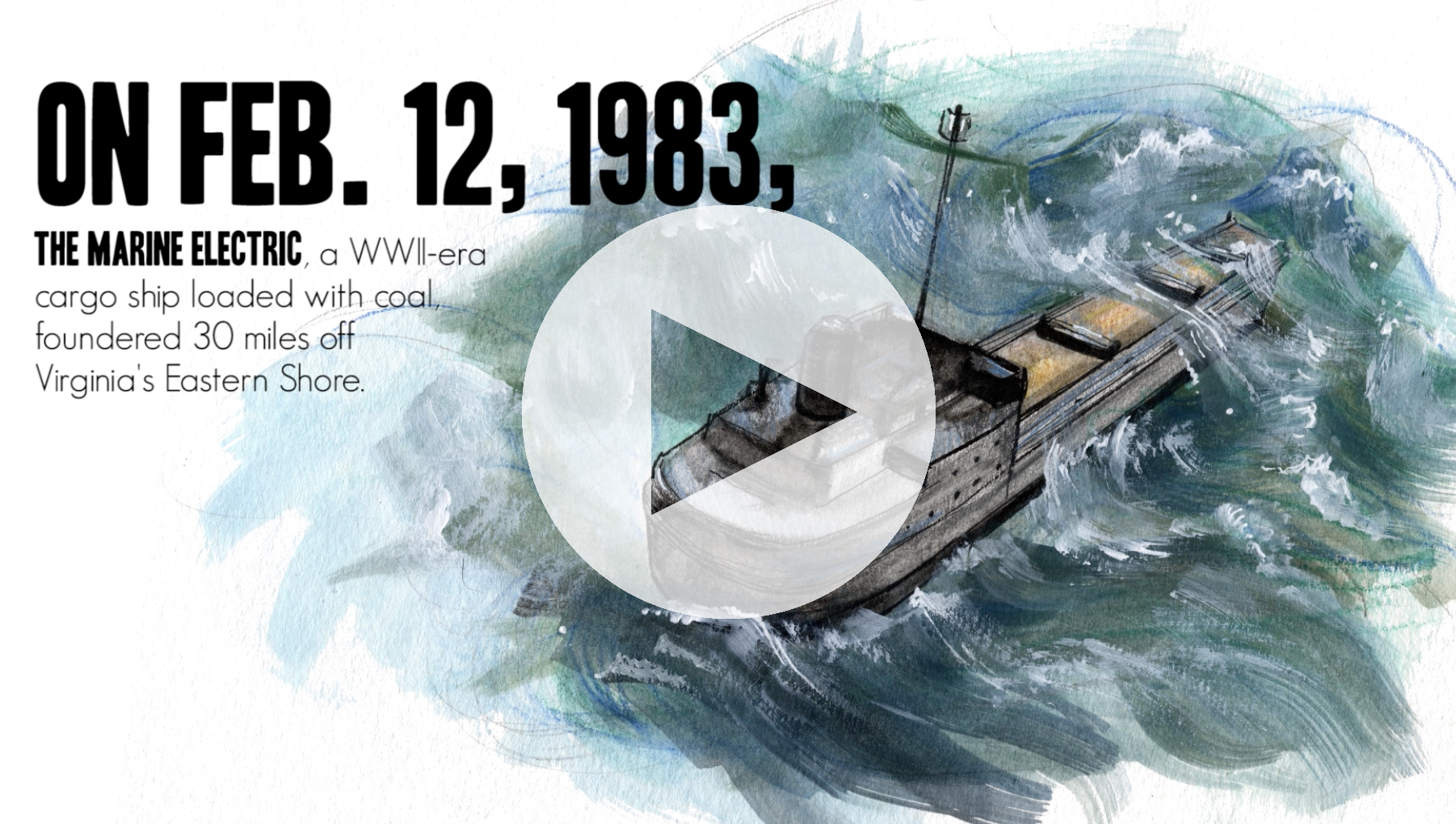
When the clock tolled 12 a.m. on Feb. 12, 1983, the 605-foot cargo ship Marine Electric trekked northward 30 miles off Virginia's Eastern Shore, plowing slowly through the gale-force winds and waves stirred up by a winter storm.
An able-bodied seaman relieved the watch and peered forward, noticing for the first time that the ship's bow seemed to be riding unusually low in the water. Dense curls of green ocean rushed over the bow, some of them arching 10 feet over the deck before crashing back down. The crew had been battling 25-foot waves for hours, but until now, the bow had bucked and dipped as normal.
Now it seemed only to dip.
Over the next two hours, the waves intruded with increasing vigor. The entire foredeck was swallowed in 6 feet of water. The main deck was completely awash.
At 2:30 a.m., the ship's master, Phillip Corl, summoned his chief mate, Robert Cusick, to the bridge and shared his fears: the bow was settling, they were taking on too much water, and the crew was in real trouble.
At 2:51 a.m., the captain made the first radio distress call to the Coast Guard.
"I seem to be taking on water forward," Corl said. "We need someone to come out and give us some assistance, if possible."
By the time assistance arrived, the Marine Electric had listed, rolled violently to starboard, and capsized, hurling most of its 34 crew into the 37-degree water. Chaos ensued.
Chief mate Cusick surfaced with a gasp, managed to get his bearings, and spotted a partially-submerged lifeboat nearby. After swimming through towering waves for 30 minutes, he pulled himself into the swamped boat and started thrashing his legs to stay warm.
"All the time I kept looking out and yelling out, 'lifeboat here,' just continually yelling out to keep myself going," the chief mate said. "Then I waited and prayed for daylight to come."
The Coast Guard had long since dispatched an HH-3F Pelican helicopter crew from Air Station Elizabeth City, North Carolina, and directed the crews of several cutters to the Marine Electric's position, but the tumultuous weather conditions slowed the rescuers' progress.
Naval Air Station Oceana had to recall available personnel before launching a helicopter crew, including rescue swimmer Petty Officer 2nd Class James McCann.
At 5:20 a.m., the Coast Guard helicopter crew was the first to arrive on scene. They had expected to find the Marine Electric's sailors tucked into lifeboats and rafts, but instead, they found a blinking sea of strobe lights, empty lifeboats, and bodies strewn below.
The Navy aircrew arrived and deployed McCann, who tore through the oil-slicked waves, searching for survivors. He managed to recover five unresponsive sailors before hypothermia incapacitated him.
The Coast Guard crew scoured the southern end of the search area and discovered one man, Paul Dewey, alone in a life raft. They dropped the rescue basket so he could clamber inside, then hoisted him into the helicopter. About 30 yards away, they spotted Eugene Kelly, the ship's third mate, clinging to a life ring, and lowered the basket to retrieve him.
Cusick remained huddled in his lifeboat until the sailors aboard the Berganger, a Norwegian merchant vessel whose crew was helping search the area, sighted him and notified the Coast Guard. The helicopter crew retrieved him in the rescue basket, then took off for Salisbury, Maryland, to bring the three survivors to Peninsula Regional Medical Center.
Meanwhile, more Coast Guard and Navy rescue crews converged on the scene to search for survivors.
Coast Guard Capt. Mont Smith, the operations officer at Air Station Elizabeth City, had piloted a second Pelican helicopter through turbulent headwinds for over an hour in order to reach the site.
He and his crew scanned the debris field below for signs of life. The people they saw were motionless, and it was difficult to determine whether they were simply too hypothermic to move, or deceased. Smith spotted one man and hovered over him, squinting through the whipping snow, trying to decide what to do.
"We all felt helpless," Smith said. "There was no way to know if the man was dead or alive. We had to try something."
Petty Officer 2nd Class Greg Pesch, the avionics electrical technician aboard the helicopter, volunteered to go down on the hoist cable. After some deliberation, Smith agreed.
Pesch's descent in the rescue basket was a harrowing one.
"The whole world seemed to be churning," Smith said. "I struggled to maintain a smooth hoist, but I know it was erratic."
Once in the water, Pesch grappled with the basket, trying to hold it steady as he guided the unresponsive man inside. It took several attempts, and then he scrambled into the basket himself and ascended back to the helicopter alongside the victim.
The aircrew spotted another potential survivor, and although Pesch attempted to descend again, the hoist cable spooled back on itself on the drum. The crew was forced to abort their mission and departed for nearby Salisbury Airport, where the man they had pulled from the water was pronounced dead on arrival by paramedics.
Dewey, Kelly and Cusick were the only men pulled from the ocean alive that morning. Their 31 shipmates had either succumbed to hypothermia or drowned.
All told, Coast Guard, Navy, and merchant vessel crews recovered 24 bodies from the scene of the capsizing. Seven were never found. It is likely the ship's engineers were trapped belowdecks when the vessel capsized.
"Throughout Coast Guard history, the missions of the service have been written in blood," said Dr. William Thiesen, historian, Coast Guard Atlantic Area. "Such was the case with the loss of the Marine Electric. This tragic event led to stricter marine safety regulations and the establishment of the Coast Guard's premiere rescue swimmer program."
While the incident itself served as the catalyst for the major changes to the Coast Guard and maritime community at large, the rigorous efforts of Coast Guard Capt. Domenic Calicchio brought the necessity for such changes into sharper focus.
Calicchio was one of the three marine safety officers charged with investigating the capsizing and sinking of the Marine Electric. The board of inquiry launched their investigation on July 25, 1984, and examined every aspect of the WWII-era cargo ship, its upkeep, the events leading up to its demise, and the Coast Guard's rescue efforts on that morning.
The investigation revealed that although the Marine Electric had been recently inspected several times by both the American Bureau of Shipping and the Coast Guard, marine inspectors had failed to note several discrepancies or recommend needed repairs. Investigators concluded that the casualty had most likely been caused by inadequate cargo hatches and deck plating, which allowed the crashing waves to flood the vessel's forward spaces.
Calicchio felt the Coast Guard needed to revamp its marine safety procedures and demand more of maritime companies, but more importantly, that the Coast Guard needed to demand more of itself.
His push for reform resulted in several additions to the Coast Guard's marine safety protocol, including guidance on hatch cover inspections, and new requirements for enclosed lifeboats and their launching systems, for ships' owners to provide crews with cold water survival suits, and for flooding alarms to be installed in unmanned spaces on vessels.
The Coast Guard also tightened its inspections of 20-year or older ships, which led to the near-immediate scrapping of 70 similar WWII-era vessels.
"Calicchio embodied the service's core values of honor, respect, and devotion to duty," said Thiesen. "He championed marine safety and pursued the truth even at the risk of his career of a Coast Guard officer."
While the Coast Guard changed many policies to make a safer marine environment after the the sinking of the Marine Electric, the service continues to make improvements on its marine safety program today. By 2025, it is estimated that the demand for waterborne commerce worldwide will more than double. The Coast Guard has published its Maritime Commerce Strategic Outlook in preparation for the increasing demand. 
The Marine Electric shipwreck also served as the genesis of another crucial development: the Coast Guard rescue swimmer program, which was established in 1984. The program's physical fitness standards, training and organizational structure were developed over a five-year implementation period, and in March of 1985, Air Station Elizabeth City became the first unit to receive rescue swimmers.
The first life was saved two months later.
The Marine Electric, a 605-foot cargo ship, as seen underway before its capsizing and sinking on Feb. 12, 1983. The converted WWII-era ship foundered 30 miles off the coast of Virginia and capsized, throwing most of its 34 crew into 37-degree water, where 31 of them drowned or succumbed to hypothermia. (U.S. Coast Guard photo)
-USCG-
Bookmark and Share

Coast Guard emblem 2014
   Questions for the Coast Guard? 
   Contact Us
For more Coast Guard news, visit our online newsroom here. 
STAY CONNECTED:
Visit Us on YouTube
Visit Us on Twitter
Visit Us on Facebook
Sign up for email updates
SUBSCRIBER SERVICES: 
Manage Preferences  |  Unsubscribe  |  Help

Privacy Policy | GovDelivery is providing this information on behalf of U.S. Department of Homeland Security, and may not use the information for any other purposes.
This email was sent to john@samfordemail.com

This email was sent to john@samfordemail.com using GovDelivery Communications Cloud on behalf of: U.S. Coast Guard · U.S. Department of Homeland Security · Washington, DC 20528 · 800-439-1420
GovDelivery logo

Sunday, February 10, 2019

Logbook summary -- and feeling blessed

Now that the boat is in the local area, I am transferring the scratchy log information I make underway to a more organized spreadsheet. The engine passed the 3000-hour mark on the trip home and the onboard mileage log shows it to have covered 19,867 nautical miles since new, measured by the GPS. I have personally run it now some 649 nautical miles in roughly 100 hours, although for more than half of that time either Paul Hamilton or Jim Trolinger was at the helm. This 13-year-old boat has averaged covering around 1,500 nautical miles a year in 230 hours. For both myself and the two previous owners, the average speed seems to work out to about 6.5 knots. The boat cruises at 8 knots, but the slower average is caused by no-wake zones, docking, shallow areas, etc.

The "shakedown cruise" from Herrington Harbor, near Annapolis, Maryland down to Savannah has been a great opportunity to get to know the quirks of the boat and, assisted by my able crew, a number of mysteries have been solved and issues resolved, or at least diagnosed. With some luck, there will be nothing but maintenance and new squawks to deal with after this visit to the boat yard. I plan to have the varnish re-done in the next few weeks. The much-needed paint job for the upper white portion of the boat will have to await another year's budget.

I am having a blast and feel incredibly blessed to be doing this again. Given my age, it seems to make sense to pursue something I love this much while I am still capable. Now that the boat is back from the cold Maryland winter, I am looking forward to enjoying it with my bride, who has graciously embraced this quest along with me. We began boating together before we were married, and some of our fondest memories are the many great boating trips we have enjoyed from the Gulf coast to the Bahamas to Maine. I have no doubt that new memories will be made on this boat as well. As the song said, "Our weary eyes still stray to the horizon, though down this road we've been so many times".

I have added a few more photos to the album. I will report back when we move the boat up the Ogeechee River to Ford, which should be in a few weeks. Thanks for tuning in.

Friday, February 8, 2019

Back in Georgia

Just a quick note that we have safely delivered the boat to Savannah. We arrived right at noon at the Hinckley Boat Yard in Thunderbolt after spending last night at the Skull Creek Marina on Hilton Head. It is good to be home.

Thursday, February 7, 2019

The ocean is way more fun than the Intracoastal Waterway

We arrived safely at the Charleston City Marina yesterday afternoon around 5:30. It was a spectacular day at sea, and very relaxing compared to the constant attention required to drive in the Waterway, with twists and turns, bridges, and shallow spots to look out for. With another day of calm seas promised today, we decided to change our plans and go to sea again. We are headed now to Port Royal Sound at the north end of Hilton Head, so we are bypassing Beaufort altogether, and giving us a short run tomorrow to Savannah. We should get inside the sound and somewhere to anchor or tie up before dark today.

Check out the photo album, as I have added a few this trip. 

Wednesday, February 6, 2019

First time at sea

It is 10 am Wednesday morning, February 6, 2019, and we are officially at sea for the first time on Division Belle. Seas are very calm with gentle swells of less than two feet. The wind is from the east at six knots. We left Georgetown, SC this morning at 8 am and came down the river to enter the ocean from Winyah Bay. We are headed for Charleston and should reach the ship channel there by around 4 pm.

Our first two days have been outstanding with beautiful weather and only a few shallow spots to navigate in the Intracoastal Waterway. Monday night was spent in North Myrtle Beach at a friendly marina called Barefoot Resort. A guy there runs a "concierge" service and for less than the price of Uber he took Paul Hamilton to Walmart to purchase a mount for our new salon TV. It is now installed with satellite TV working, but only a temporary antenna stuck to the window (purchased for $15 to allow us to watch the Super Bowl Sunday night, such as it was). There was no restaurant open on the property so we dined onboard.

Yesterday, Tuesday, we spent the entire day in t-shirts driving from the flying bridge. We departed Myrtle Beach at 9:45 and arrived at 4 pm in Georgetown, a historic and quaint little town with houses dating to before the American revolution. We had dinner last night at the "River Room", which was excellent. 

The high in Georgetown today is expected to be 74 degrees, and Charleston will be even warmer as we continue to move south. We expect to travel from Charleston to Beaufort, SC tomorrow and on to Savannah Friday.

Monday, February 4, 2019

Back on the boat

We are back on the boat. Paul Hamilton and I drove up from home to Southport, NC yesterday in a rental car. It is interesting that we could drive up in just over five hours, but the trip home on the boat will take more than five days (50 miles per hour or 50 miles per day). The weather was cold and rainy when we arrived, but promises to be great for the week. We had planned to head out this morning with stops in Myrtle Beach, Georgetown, Charleston, and Beaufort, SC, but it now appears we will be here one more day to finish up a few items.
We might have some options along the way to go offshore, depending on the weather. Georgetown to Charleston would be a good day to do so, as would Beaufort to Savannah, but we shall see.

The boat has been something of a movable repair project so far. Many issues have been resolved in Southport and there will no doubt be many more as we arrive close to home. This is, all-in-all, a great boat, but apparently no one did any maintenance for the past several years. We are making progress, and I won't bore you with the details.


We came up bearing the new flag of our home port at The Ford Plantation. We hoisted it today on the bow.

UPDATE @ 10  PM Monday 2.4.19: Many things came together early today, and we did indeed get away from Southport at around 10 am this morning. It was a beautiful day of cruising, with temperatures reaching around 70. We arrived mid-afternoon in Myrtle Beach, SC. 

Please click "Where's the boat?" above to track our progress.